Signing Info:
Transferred from: Birmingham City, 08/1951, £15,000
Previous Clubs:
Birmingham City
Debut:
01/09/1951 v Bolton Wanderers (A) 0-1 (League Division One)
Farewell:
Retired due to Injury's sustained from Munich Air Disaster, 02/1958
Passed Away:
16/09/1994 (age 68)
Biography
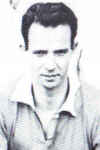
Johnny Berry was a quick, skilful outside-right who played an important role in three Manchester United championship-winning teams during the 1950s. An established senior player among Matt Busby’s emerging young side, Berry made 276 competitive appearances for United and scored 45 goals before injuries sustained in the Munich Air Disaster brought his career to a premature end.
Born in Aldershot, Hampshire, on 1 June 1926, Berry’s full name has been recorded as both Reginald John Berry and John James Berry. He attended St Joseph’s School and played for Aldershot YMCA during his youth. Although reportedly rejected by his hometown club because of his small stature, he attracted the attention of Birmingham City while serving with the Royal Artillery. Berry signed professionally for Birmingham and established himself in their first team following the Second World War. He made 104 Football League appearances for the club, scoring six goals, and helped Birmingham win the Second Division championship in 1947/1948. His pace, close control and ability to beat defenders made him an attractive prospect to Manchester United manager Matt Busby. United signed Berry from Birmingham City for approximately £15,000 in August 1951. He made his debut on 1 September 1951, appearing in a 1–0 First Division defeat against Bolton Wanderers at Burnden Park. His first United goal arrived two weeks later when he opened the scoring in a 2–1 victory away to Manchester City.
Berry immediately became a regular on the wing and made 37 appearances during his first season as United won the 1951/1952 First Division championship. It was the club’s first league title for 41 years and the first major trophy of Matt Busby’s reign. Small in stature but difficult to dispossess, Berry possessed excellent balance, acceleration and close control. He was a traditional outside-right who could stretch opposing defences, deliver crosses and move inside to score important goals. His experience also proved valuable as Busby gradually introduced the young footballers who became known as the Busby Babes. Berry remained a prominent member of the side that captured consecutive First Division titles in 1955/1956 and 1956/1957. He also helped United win the FA Charity Shield in 1952, 1956 and also scored a late penalty v Newcastle United in 1957.
One of his most memorable performances came against Athletic Bilbao in the European Cup quarter-final on 6 February 1957. United had lost the first leg 5–3 in Spain and needed a victory at Maine Road to remain in the competition. With United leading 2–0 and the tie finely balanced, Berry scored the decisive third goal five minutes from time to complete a famous 3–0 victory and send Busby’s team into the semi-finals.
Berry also appeared in the 1957 FA Cup final, when United were defeated 2–1 by Aston Villa at Wembley. Had United won, they would have become the first English club of the 20th century to complete the League and FA Cup Double. Despite playing during an era containing outstanding English wingers such as Stanley Matthews and Tom Finney, Berry earned four senior England caps between 1953 and 1956. He made his international debut against Argentina in Buenos Aires in May 1953 and also represented England B.
During the 1957/1958 season, Berry faced increasing competition from the teenage Kenny Morgans. His final United appearance came in a 2–1 victory over Fulham at Old Trafford on 28 December 1957. Although he did not play in United’s European Cup match against Red Star Belgrade on 5 February 1958, he travelled with the team to Yugoslavia.
Berry was among those seriously injured when the team’s aircraft crashed at Munich-Riem Airport on 6 February. He suffered a fractured skull and jaw as well as injuries to his elbow, pelvis and leg. He was unconscious for several weeks and initially had no memory of the disaster. Because of the severity of his condition, he was not immediately told that several of his teammates had died.
Although Berry survived, his injuries were too serious for him to resume his football career. He never played professionally again and retired at the age of 32. His United career ended with an impressive record of 276 appearances and 45 goals.
After leaving football, Berry worked for Massey Ferguson before returning to the Aldershot area. He later ran a sports shop with his younger brother Peter, who had also been a professional footballer.
Johnny Berry died following a short illness in Farnham, Surrey, on 16 September 1994, aged 68. He was the first of the surviving United players from the Munich Air Disaster to pass away.
Although his career is inevitably associated with the tragedy that ended it, Berry deserves to be remembered above all as one of the finest right-wingers of Matt Busby’s first great Manchester United side. A three-time league champion, he provided experience, creativity and important goals during the transition from United’s first post-war championship team to the celebrated Busby Babes.