Signing Info:
Signed Trainee: 01/1953. Signed Professional: 25/10/1954
Previous Clubs:
Debut:
08/10/1955 v Wolverhampton Wanderers (H) 3-2 (League Division One)
Farewell:
Retired from game due to injury, 1961
Passed Away:
Biography
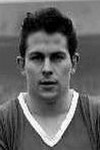
Wilfred “Wilf” McGuinness was born in Manchester on 25 October 1937. A determined and energetic wing-half, he belonged to the celebrated generation of young Manchester United players known as the Busby Babes. He later served the club as a coach, reserve-team manager and, most famously, as the difficult immediate successor to Sir Matt Busby.
McGuinness demonstrated natural leadership from an early age, captaining Manchester, Lancashire and England at schoolboy level. He joined Manchester United in 1953 and developed through the club’s outstanding youth system alongside players such as Bobby Charlton, Duncan Edwards and Eddie Colman. McGuinness helped United win three successive FA Youth Cups as the club established the foundations of one of the most gifted young teams in British football. Manchester United’s Academy history
He made his senior debut shortly before his eighteenth birthday, appearing in a 2–1 First Division victory over Wolverhampton Wanderers at Old Trafford on 8 October 1955. Competition for places was intense, particularly with Duncan Edwards established in the half-back line, but McGuinness gradually earned further first-team opportunities.
A tenacious ball-winner with excellent stamina, he was capable of playing across the half-back positions. McGuinness was not a prolific goalscorer, but his hard running, positional discipline and competitive character made him an effective member of Matt Busby’s youthful squad.
He played during United’s championship-winning seasons of 1955/56 and 1956/57 and continued to make progress during the following campaign. However, an injury prevented him from travelling to Belgrade for United’s European Cup match against Red Star in February 1958. He therefore remained in Manchester and escaped the Munich air disaster, in which eight of his teammates lost their lives.
The tragedy had a profound and lasting effect on McGuinness. He later recalled believing that the disaster might represent the end of Manchester United, but Busby, Jimmy Murphy and the surviving players rebuilt the team amid unimaginable grief. McGuinness returned to first-team action and enjoyed his most productive campaign in 1958/59, when he became a regular member of the side that finished as First Division runners-up.
His performances also brought international recognition. McGuinness made his senior England debut against Northern Ireland at Wembley on 4 October 1958 and won his second cap against Italy at the San Siro in May 1959. He had previously represented England at schoolboy, youth and under-23 levels.
McGuinness appeared to have a substantial playing career ahead of him, but disaster struck during a reserve-team match against Stoke City in December 1959. He suffered a badly broken leg and, despite attempts to return, the injury ultimately ended his playing career when he was only 22. He had made 85 competitive appearances for Manchester United, including 81 in the league, and scored two goals.
Although he could no longer contribute on the pitch, Sir Matt Busby recognised his intelligence, enthusiasm and leadership qualities and offered him the opportunity to enter coaching. McGuinness worked with United’s younger players and became reserve-team manager in 1964, succeeding Jimmy Murphy in the role.
His reputation as a progressive young coach also led to involvement with the England national team. McGuinness served as a trainer on Alf Ramsey’s staff when England won the World Cup at Wembley in 1966, giving him experience at the highest level of international football.
When Busby stepped down as Manchester United manager in 1969, the club chose to promote from within. McGuinness, still only 31, was handed the formidable task of succeeding the man who had shaped United for more than two decades.
He inherited a side containing legendary figures such as Bobby Charlton, Denis Law and George Best, but the European Cup-winning team of 1968 was beginning to age. Busby also remained at the club as general manager, making it difficult for his young successor to establish complete authority.
McGuinness encouraged demanding fitness work and attempted to refresh the squad, but results were inconsistent. United finished eighth in the First Division during his only complete season in charge. Nevertheless, he led the club to three domestic cup semi-finals—two in the League Cup and one in the FA Cup—and came close to reaching a final.
His position became increasingly difficult during the 1970/71 campaign. Following an extraordinary 4–4 draw against Derby County at the Baseball Ground, McGuinness was relieved of his first-team duties on 29 December 1970. Busby temporarily returned as manager until the appointment of Frank O’Farrell the following summer. Manchester United’s own historical account acknowledges the challenge McGuinness faced while trying to control an ageing and complicated squad.
McGuinness returned briefly to his previous role with United’s reserves before continuing his managerial career abroad. He took charge of Aris Thessaloniki in Greece in 1971 and later managed Panachaiki, leading the latter through its first European campaign in the 1973/74 UEFA Cup.
He returned to England to manage York City in 1975 and later worked at Hull City, initially as assistant manager and then as caretaker. McGuinness subsequently spent many years on the coaching staff at Bury and briefly served as the club’s caretaker manager in 1989.
His family’s connection with Manchester United continued through his son, Paul McGuinness, who spent 28 years working in the club’s Academy and helped guide numerous young players towards professional careers.
Wilf McGuinness’s time as United manager is often judged against the impossible standard established by Sir Matt Busby. His wider contribution to the club, however, was considerable. He was a successful youth player, a member of the Busby Babes, a senior England international, a dedicated coach and one of the few men to have represented Manchester United both on the pitch and in the manager’s office.
His playing career was cruelly shortened, while his managerial appointment came at one of the most difficult transitional moments in the club’s history. Through it all, McGuinness retained a deep affection for Manchester United and remained an important link to the Busby era—one of the young players who experienced its triumphs, endured its greatest tragedy and helped carry its values into subsequent generations.