Signing Info:
Transferred from: West Bromwich Albion, 01/1960, £30,000
Previous Clubs:
Exeter City, West Bromwich Albion
Debut:
16/01/1960 v Birmingham City (H) 2-1 (League Division One)
Farewell:
Transferred to Stoke City, 11/1964, £30,000
Passed Away:
22/11/2020 (age 83)
Biography
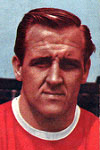
Maurice Edgar Setters was born in Honiton, Devon, on 16 December 1936. A powerful and uncompromising half-back, he represented Manchester United between 1960 and 1964 and became an influential member of the side that won the 1963 FA Cup. He later enjoyed a long coaching career and played an important part in the Republic of Ireland’s emergence on the international stage under Jack Charlton.
Setters began his football career with his local professional club, Exeter City. Originally employed as a winger, he was converted into a right-half and made his Football League debut against Southend United in March 1954, when he was only 17.
After 11 first-team appearances in all competitions for Exeter, his potential attracted the attention of West Bromwich Albion. The financially troubled Devon club reluctantly sold him to Albion for approximately £3,000 in January 1955.
Setters established himself as an effective First Division footballer at The Hawthorns. Although only around five feet seven inches tall, he was powerfully built, fiercely competitive and capable of imposing himself physically on a match. He became known as one of the toughest half-backs of his generation.
His performances brought international recognition at under-23 level, for which he represented England 16 times. Setters was also included in England’s provisional party for the 1958 World Cup in Sweden, although he was not selected for the final travelling squad and never received a senior international cap. The Grecian Archive
Matt Busby was rebuilding Manchester United following the Munich air disaster and wanted greater experience and physical strength in his team. In January 1960, United signed Setters from West Bromwich Albion for £30,000.
He made his Manchester United debut at Old Trafford on 16 January 1960, helping the team defeat Birmingham City 2–1 in the First Division. Setters quickly became an important figure in the side and was occasionally entrusted with the captaincy.
Primarily used as a wing-half, he provided defensive protection and physical authority in midfield. Setters was a forceful tackler who competed for every ball and rarely allowed an opponent to settle. His aggressive playing style contrasted effectively with the flair and attacking ability of teammates such as Bobby Charlton, Albert Quixall and, later, Denis Law.
Behind his formidable on-field reputation was a strong sense of loyalty towards his teammates. Setters formed a particularly close friendship with Bobby Charlton and served as best man at Charlton’s wedding to Norma Ball in 1961.
The arrival of Denis Law in 1962 and the emergence of young players such as George Best helped United make substantial progress. Setters supplied experience, resilience and determination to a developing team that was preparing to challenge again for major honours.
His greatest achievement as a Manchester United player came during the 1962/63 FA Cup campaign. United defeated Huddersfield Town, Aston Villa, Chelsea, Coventry City and Southampton to reach the final against Leicester City at Wembley.
Setters started at right-half in the final on 25 May 1963. United produced an excellent performance, with two goals from David Herd and another from Denis Law securing a 3–1 victory. It was the club’s first major trophy since the Munich air disaster and represented an important milestone in Busby’s construction of another great United side.
Setters continued to feature regularly during the following campaign, when United finished second in the First Division and reached the European Cup Winners’ Cup semi-finals. However, competition for places increased following the arrival of Paddy Crerand and the development of Nobby Stiles.
In November 1964, Setters left Manchester United and joined Stoke City for £30,000—the same fee United had paid West Bromwich Albion for him. He departed having made 194 competitive appearances for the club. His United record included 159 league appearances and 12 league goals.
At Stoke, Setters joined a side containing several distinguished and experienced players, including Stanley Matthews and former United forward Dennis Viollet. He made 86 league appearances for the Potters before moving to Coventry City in 1967 for approximately £25,000.
Setters helped Coventry compete in the First Division under manager Noel Cantwell, another former Manchester United captain. He subsequently had a brief spell with Charlton Athletic and also appeared in North America for the Cleveland Stokers before bringing his playing career to an end.
In total, Setters made more than 500 senior appearances during a playing career that spanned almost two decades. His consistency, durability and combative qualities made him a respected—if sometimes feared—opponent throughout the Football League.
After retiring as a player, Setters entered management with Doncaster Rovers in 1971. He remained in charge until 1974, although his departure occurred in difficult circumstances and was followed by a successful claim for unfair dismissal.
He later returned to coaching with Sheffield Wednesday, where he began a productive working relationship with Jack Charlton. Setters possessed many of the characteristics Charlton valued: honesty, discipline, resilience and a willingness to communicate directly with players.
Setters subsequently worked at Rotherham United and Newcastle United before Charlton appointed him assistant manager of the Republic of Ireland in 1986. The partnership became one of the most successful in Irish football history.
Charlton provided the public leadership, while Setters became a trusted organiser, coach and disciplinarian behind the scenes. Together they helped the Republic of Ireland qualify for its first major international tournament, UEFA Euro 1988 in West Germany. Ireland famously defeated England 1–0 in Stuttgart through Ray Houghton’s early goal.
The pair then guided Ireland to its first World Cup finals in 1990. The team reached the quarter-finals without winning a match in normal time, defeating Romania on penalties before losing narrowly to hosts Italy in Rome.
Setters remained Charlton’s assistant as Ireland qualified for the 1994 World Cup in the United States. Another famous victory over Italy helped the team reach the knockout stage for the second successive tournament. Setters also had responsibility for the Republic of Ireland under-21 side during his association with the national team.
His contribution was sometimes overshadowed by Charlton’s larger public profile, but players and officials recognised Setters as an important part of the organisation, preparation and spirit that characterised Ireland’s most successful international era. BBC Sport
In later life, Setters lived in the Doncaster area. He was diagnosed with Alzheimer’s disease and spent his final years in residential care. He died at Doncaster Royal Infirmary on 22 November 2020 at the age of 83.
Manchester United remembered him as a former captain and FA Cup winner who made 194 appearances for the club. The Football Association of Ireland also paid tribute to the important role he played during the country’s historic appearances at Euro 1988 and the 1990 and 1994 World Cups. The Irish Times
Maurice Setters was one of the most formidable competitors of his era. His physical approach and uncompromising manner were central to his effectiveness, but his career amounted to far more than his reputation as a hard man. He was a Manchester United captain, an FA Cup winner, a respected coach and a central member of the backroom team that helped transform the fortunes of the Republic of Ireland.