Previous Clubs:
Coventry City, Luton Town, Plymouth Argyle (loaned), Aston Villa
Debut:
14/04/1990 v Queens Park Rangers (A) 2-1 (League Division One)
Farewell:
1st Farewell End of loan from Luton Town, 1990, Final Farewell Transferred to Blackpool, 30/06/1994,
Passed Away:
19/08/2001 (age 43)
Biography
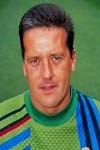
Leslie Jesse “Les” Sealey was born in Bethnal Green, London, on 29 September 1957. A courageous, outspoken and fiercely competitive goalkeeper, he became a cult hero at Manchester United after playing decisive roles in the club’s 1990 FA Cup triumph and 1991 European Cup Winners’ Cup victory.
Sealey began his career as an apprentice with Coventry City in 1975. He made his senior debut at the age of 19 against Queens Park Rangers on 11 April 1977 and gradually established himself in the Coventry first team. Strong, agile and an excellent communicator, he made more than 170 appearances in all competitions before leaving Highfield Road in 1983.
Luton Town signed Sealey for approximately £100,000 in August 1983. He immediately became the club’s first-choice goalkeeper, appearing in every league match during his first season at Kenilworth Road. Apart from a brief loan spell with Plymouth Argyle, he remained a prominent member of the Luton side for much of the decade.
An injury prevented Sealey from playing in Luton’s famous 3–2 League Cup final victory over Arsenal in 1988. He did appear at Wembley the following year, however, when Luton were defeated 3–1 by Nottingham Forest in the 1989 final. After subsequently losing his first-team place, he became available for a move.
Manchester United brought Sealey to Old Trafford on loan in December 1989 as experienced cover for Jim Leighton and Gary Walsh. He made his United debut on 14 April 1990, helping Alex Ferguson’s side record a 2–1 league victory away to Queens Park Rangers. Three days later, he kept a clean sheet in a 2–0 win over Aston Villa.
Sealey’s Manchester United career changed dramatically following the 1990 FA Cup final against Crystal Palace. Leighton endured a difficult afternoon as United drew 3–3 after extra time, and Ferguson made the bold decision to replace him with Sealey for the replay five days later.
Despite having played only twice for United, Sealey approached the occasion with characteristic confidence. He produced an assured performance at Wembley and kept a clean sheet as Lee Martin’s goal secured a 1–0 victory. The result delivered Manchester United’s first major trophy under Ferguson and became an important turning point in the club’s modern history.
Sealey demonstrated his generosity after the final by offering his winners’ medal to Leighton, who had played throughout the earlier rounds. The Football Association eventually awarded medals to both goalkeepers. Sealey’s performance also convinced United to sign him permanently following the conclusion of his Luton contract in June 1990.
During the 1990/91 season, Sealey was Manchester United’s regular goalkeeper. His forceful personality and willingness to place himself in danger made him popular with supporters and teammates. He made 51 appearances in all competitions as United competed at home and returned to European football following the lifting of the ban on English clubs.
Sealey played in the 1991 League Cup final against Sheffield Wednesday but suffered a serious knee injury during the match. With no substitute goalkeeper available, he refused to leave the field and completed the game despite being in considerable pain. United lost 1–0, and the resulting injury and infection reportedly placed his health in serious danger.
Remarkably, Sealey recovered in time to play in the European Cup Winners’ Cup final against Barcelona in Rotterdam on 15 May 1991. Two goals from Mark Hughes gave United a 2–1 victory, although Ronald Koeman’s late free kick ensured a tense conclusion. Sealey again finished the match in discomfort after being hurt in a collision, but he remained in goal and helped United secure their first European trophy since 1968.
That triumph proved to be Sealey’s final appearance of his first spell at Old Trafford. He wanted the security of a longer contract, but United offered him only a one-year agreement. He therefore left in July 1991 and joined Aston Villa on a free transfer.
Sealey began the 1991/92 season as Villa’s first-choice goalkeeper before eventually losing his place to Nigel Spink. He later spent periods on loan with Coventry City and Birmingham City before returning to Manchester United in January 1993 as understudy to Peter Schmeichel.
Opportunities during his second United spell were limited, but Sealey made two memorable appearances. He replaced Schmeichel after the Dane was dismissed during United’s 3–1 FA Cup quarter-final victory over Charlton Athletic in March 1994. With Schmeichel suspended, Sealey was then selected for the League Cup final against his former club Aston Villa, which United lost 3–1.
Sealey left Old Trafford for a second time during the summer of 1994. In total, he made 56 competitive appearances for Manchester United, recording 32 victories, 14 draws and ten defeats. His five final appearances for the club included victories in the FA Cup and European Cup Winners’ Cup finals, alongside three League Cup finals.
After leaving United, Sealey played briefly for Blackpool before joining West Ham United, the club he had supported as a boy. An injury crisis led to one particularly unusual appearance against Arsenal in September 1995, when the veteran goalkeeper was introduced as an outfield substitute.
Sealey subsequently played for Leyton Orient before returning to West Ham in December 1996. His final senior appearance came against Manchester United at Old Trafford on the last day of the 1996/97 season. He later became West Ham’s goalkeeping coach while remaining registered as a player.
Les Sealey died suddenly following a heart attack on 19 August 2001. He was only 43 years old. He left his wife, Elaine, and sons Joe and George, both of whom were young goalkeepers associated with West Ham at the time.
Sealey’s Manchester United career was relatively short, but its significance was considerable. His fearless performance in the 1990 FA Cup final replay helped secure the first trophy of the Ferguson era, while his determination in Rotterdam contributed to United’s return to prominence in European football. Remembered for his confidence, bravery and larger-than-life personality, Les Sealey remains one of Old Trafford’s most cherished cult heroes.