Signing Info:
Signed Trainee: 05/1946. Signed Professional: 08/1946
Previous Clubs:
Liverpool (WW2), Manchester City (WW2), Rotherham United (WW2)
Debut:
26/10/1946 v Sunderland (Maine Road)) 0-3 (League Division One)
Farewell:
Transferred to Huddersfield Town, 06/1949, 16,000k
Passed Away:
12/2003
Biography
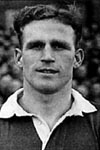
Ronald Stewart “Ronnie” Burke was an English centre-forward who represented Manchester United during the formative years of Matt Busby’s reign, establishing himself as a highly effective goalscorer despite making only 35 competitive appearances for the club. Burke scored an impressive 23 goals for United, including 16 in 28 league appearances, giving him an excellent scoring record during his three seasons at the club.
Born on 13 August 1921 in Dormo, Redcar, England, Burke’s early footballing career was disrupted by the Second World War. He played football during the wartime period before joining Manchester United in 1946, initially signing as a trainee in May and becoming a professional that August. He was already 25 by the time his Football League career properly began, but he quickly demonstrated his ability in front of goal.
Burke made his Manchester United debut on 26 October 1946, when United were beaten 3–0 by Sunderland at Maine Road, the temporary home being used by the club while Old Trafford underwent repairs following wartime bomb damage. He soon found his scoring touch and netted twice against Charlton Athletic in a 4–1 victory on 4 January 1947. Further goals followed against Aston Villa, Derby County, Everton and Leeds United as Burke became a useful attacking option in Busby’s developing side.
His first season proved particularly productive. Burke scored nine goals from 13 league appearances during 1946/47, an excellent return in a Manchester United team that finished runners-up in the First Division. His opportunities became more limited during 1947/48, when he made six league appearances and scored once.
Burke returned to prominence during 1948/49, producing the most prolific spell of his United career. He scored 13 goals in 16 appearances in all competitions, including six goals from nine league matches and six from six FA Cup appearances. He also scored against Arsenal in the 1948 Charity Shield.
His FA Cup form was particularly impressive. Burke scored twice as United defeated Bournemouth 6–0 in the third round, added another two in the 5–0 replay victory over Bradford Park Avenue and struck twice more as United overwhelmed Yeovil Town 8–0. United eventually reached the semi-final, where their defence of the FA Cup ended with a 1–0 defeat against Wolverhampton Wanderers.
Burke's final Manchester United appearance came on 30 April 1949 where he scored a late winner away to Newcastle United, and he finished his career at Old Trafford with 35 competitive appearances and 23 goals. His record comprised 16 goals in 28 First Division appearances, six goals in six FA Cup matches and one goal in his single Charity Shield appearance.
In June 1949, Burke left Manchester United for Huddersfield Town. He later enjoyed an especially productive spell with Rotherham United, scoring 56 league goals in 73 appearances. One of his most remarkable performances came when he scored all four goals in a 4–2 victory over Bury in March 1955.
Burke subsequently joined Exeter City in 1955 and finished as the club's leading scorer during his first season. After leaving Exeter he continued playing in non-League football with Tunbridge Wells and Biggleswade Town before eventually retiring. Burke died in Watford in December 2003, aged 82.
Although Ronnie Burke's Manchester United career was relatively brief, his goalscoring statistics underline his effectiveness. Twenty-three goals in just 35 competitive appearances represents a strike rate of almost two goals every three games. Playing during the early years of Matt Busby's rebuilding of Manchester United after the Second World War, Burke was one of several talented forwards who helped establish the foundations for the successful side that would develop at Old Trafford during the following decade.